1.Cerberus

In Greek mythology, Cerberus, often called
the "hound of Hades", is the monstrous multi-headed dog that guards
the gates of the Underworld to prevent the dead from leaving. Cerberus was the
offspring of the monsters Echidna and Typhon, and usually is described as
having three heads, a serpent for a tail, and snakes protruding from parts of
his body. Cerberus is primarily known for his capture by Heracles, one of
Heracles' twelve labours.
2.Brothers Grimm

The Brothers Grimm, Jacob (1785–1863) and
Wilhelm Grimm (1786–1859), were German academics, philologists, cultural
researchers, lexicographers and authors who together specialized in collecting
and publishing folklore during the 19th century. They were among the best-known
storytellers of folk tales, and popularized stories such as
"Cinderella" ("Aschenputtel"), "The Frog Prince"
("Der Froschkönig"), "The Goose-Girl" ("Die Gänsemagd"),
"Hansel and Gretel" ("Hänsel und Gretel"), "Rapunzel",
"Rumpelstiltskin" ("Rumpelstilzchen"),"Sleeping
Beauty" ("Dornröschen"), and "Snow White"
("Schneewittchen"). Their first collection of folk tales, Children's
and Household Tales (Kinder- und Hausmärchen), was published in 1812.
The brothers spent their formative years in
the German town of Hanau. Their father's death in 1796 caused great poverty for
the family and affected the brothers for many years after. They both attended
the University of Marburg where they developed a curiosity about German
folklore, which grew into a lifelong dedication to collecting German folk
tales. The rise of romanticism during the 19th century revived interest in
traditional folk stories, which to the brothers represented a pure form of
national literature and culture. With the goal of researching a scholarly
treatise on folk tales, they established a methodology for collecting and
recording folk stories that became the basis for folklore studies. Between 1812
and 1857, their first collection was revised and republished many times,
growing from 86 stories to more than 200. In addition to writing and modifying
folk tales, the brothers wrote collections of well-respected German and
Scandinavian mythologies, and in 1838 they began writing a definitive German
dictionary (Deutsches Wörterbuch), which they were unable to finish during
their lifetimes.
The popularity of the Grimms' best folk
tales has endured well. The tales are available in more than 100 languages and
have been later adapted by filmmakers including Lotte Reiniger and Walt Disney,
with films such as Snow White and the Seven Dwarfs and Sleeping Beauty. During
the 1930s and 40s, the tales were used as propaganda by the Third Reich; later
in the 20th century psychologists such as Bruno Bettelheim reaffirmed the value
of the work, in spite of the cruelty and violence in original versions of some
of the tales, which the Grimms eventually sanitized.
3.Old King Cole
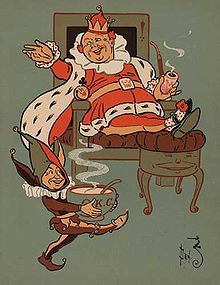
"Old King Cole" is a British
nursery rhyme first attested in 1708. Though there is much speculation about
the identity of King Cole, it is unlikely that he can be identified reliably as
any historical figure. It has a Roud Folk Song Index number of 1164. The poem
describes a merry king who called for his pipe, bowl, and musicians, with the
details varying among versions.
The most common modern version of the rhyme
is:
Old King Cole was a merry old soul,
And a merry old soul was he;
He called for his pipe, and he called for
his bowl,
And he called for his fiddlers three.
Every fiddler he had a fiddle,
And a very fine fiddle had he;
Oh there's none so rare, as can compare,
With King Cole and his fiddlers three.
4.nursery rhyme

A nursery rhyme is a traditional poem or
song for children in Britain and many other countries, but usage of the term
only dates from the late 18th/early 19th century. In North America the term
Mother Goose Rhymes, introduced in the mid-18th century, is still often used.
From the mid-16th century they begin to be
recorded in English plays, and most popular nursery rhymes date from the 17th
and 18th centuries. The first English collections, Tommy Thumb's Song Book and
a sequel, Tommy Thumb's Pretty Song Book, were published before 1744. John
Newbery's compilation of English rhymes, Mother Goose's Melody, or, Sonnets for
the Cradle (London, c. 1765), is the first record we have of many classic
rhymes, still in use today.
5.Charles Perrault

Charles Perrault (French: [ʃaʁl pɛʁo]; 12 January 1628 – 16 May
1703) was a French author and member of the Académie Française. He laid the
foundations for a new literary genre, the fairy tale, with his works derived
from pre-existing folk tales. The best known of his tales include Le Petit
Chaperon Rouge (Little Red Riding Hood), Cendrillon (Cinderella), Le Chat Botté
(Puss in Boots), La Belle au bois Dormant (The Sleeping Beauty), and Barbe
Bleue (Bluebeard).[1] Some of Perrault's versions of old stories have
influenced the German versions published by the Brothers Grimm more than 100
years later. The stories continue to be printed and have been adapted to opera,
ballet (such as Tchaikovsky's The Sleeping Beauty), theatre, and film. Perrault
was an influential figure in the 17th-century French literary scene, and was
the leader of the Modern faction during the Quarrel of the Ancients and the
Moderns.
The King Cole Bar is an upscale cocktail
lounge in The St. Regis Hotel in Midtown Manhattan, New York City.
Many mixologists believe the Bloody Mary
made its first U.S. appearance in the King Cole Bar. The drink was then called
"The Red Snapper," after originally being invented by Fernand Petiot
at Harry's New York Bar in Paris, France. Others contend that the iconic drink,
now one of the Official Cocktails of the International Bartenders Association,
was indeed invented in the King Cole Bar. Originally, the King Cole Bar was
about fifty feet east of the small but ornate lobby of The St. Regis. It was a
large room with many circular tables and a long north-south bar above which was
the famous Parrish painting. In more recent years, the bar was moved to a far
smaller room east of that spot. The wonderful mural, or perhaps a slightly
smaller version of the painting, is still in the bar. It features "Old
King Cole" who was a "merry old soul" calling for his 'fiddlers
three' and some other musicians.
The lounge has a large mural by artist
Maxfield Parrish hanging behind the bar, from which the venue derives its name

The Devil Wears Prada is a 2006 American
comedy-drama film based on Lauren Weisberger's 2003 novel of the same name.
This screen adaptation stars Meryl Streep as Miranda Priestly, a powerful
fashion magazine editor, and Anne Hathaway as Andrea ("Andy") Sachs,
a college graduate who goes to New York City and lands a job as Priestly's
co-assistant. Emily Blunt and Stanley Tucci co-star, as co-assistant Emily
Charlton and art director Nigel, respectively.
Adrian Grenier, Simon Baker, and Tracie
Thoms play key supporting roles. Wendy Finerman produced and David Frankel
directed the film, which was distributed by 20th Century Fox. Streep's
performance drew critical acclaim and earned her many award nominations,
including her record-setting 14th Oscar bid, as well as the Golden Globe for
Best Actress in a Comedy or Musical. Blunt also drew favorable reviews and
nominations for her performance, as did many of those involved in the film's
production.
The film was well received by both film
critics and the public and became a surprise summer box-office hit following
its June 30 North American release. The commercial success and critical praise
for Streep's performance continued in foreign markets with the film leading the
international box office for most of October. Likewise, the U.S. DVD release
was the top rental during December. The film finished in 2006's Top 20 both in
the U.S. and overseas and grossed over $300 million, mostly from its
international run.
Although the movie is set in the fashion
world, most designers and other fashion notables avoided appearing as
themselves for fear of displeasing U.S. Vogue editor Anna Wintour, who is
widely believed to have been the inspiration for Priestly. Still, many allowed
their clothes and accessories to be used in the film, making it one of the most
expensively costumed films in history. Wintour later overcame her initial
skepticism, saying she liked the film and Streep in particular.

Don Quixote (/ˌdɒn kiːˈhoʊti/[1] Spanish: [doŋ kiˈxote]
( listen), fully titled The history of the valorous and wittie Knight-Errant
Don-Quixote of the Mancha (Spanish: El ingenioso hidalgo don Quixote de la
Mancha [el iŋxeˈnjoso
iˈðalɣo ðoŋ kiˈxote ðe la ˈmantʃa]), is a Spanish novel by Miguel de Cervantes Saavedra.
Published in two volumes, in 1605 and 1615, Don Quixote is considered the most
influential work of literature from the Spanish Golden Age and the entire
Spanish literary canon. As a founding work of modern Western literature and one
of the earliest canonical novels, it regularly appears high on lists of the
greatest works of fiction ever published, such as the Bokklubben World Library
collection that cites Don Quixote as authors' choice for the "best
literary work ever written".
The story follows the adventures of a
hidalgo named Mr. Alonso Quixano who reads so many chivalric romances that he
loses his sanity and decides to set out to revive chivalry, undo wrongs, and
bring justice to the world, under the name Don Quixote de la Mancha. He
recruits a simple farmer, Sancho Panza, as his squire, who often employs a
unique, earthy wit in dealing with Don Quixote's rhetorical orations on
antiquated knighthood. Don Quixote, in the first part of the book, does not see
the world for what it is and prefers to imagine that he is living out a
knightly story. Throughout the novel, Cervantes uses such literary techniques
as realism, metatheatre, and intertextuality. It had a major influence on the
literary community, as evidenced by direct references in Alexandre Dumas' The
Three Musketeers (1844), Mark Twain's Adventures of Huckleberry Finn (1884),
and Edmond Rostand's Cyrano de Bergerac (1897), as well as the word
"quixotic" and the epithet "Lothario". Arthur Schopenhauer
cited Don Quixote as one of the four greatest novels ever written, along with
Tristram Shandy, La Nouvelle Héloïse, and Wilhelm Meister.

"Rapunzel" (/rəˈpʌnzəl/; German pronunciation: [ʁaˈpʊnt͡səl]) is a German fairy tale in the collection assembled by the
Brothers Grimm, and first published in 1812 as part of Children's and Household
Tales.[1] The Grimm Brothers' story is an adaptation of the fairy tale Rapunzel
by Friedrich Schulz published in 1790.[2] The Schulz version is based on Persinette
by Charlotte-Rose de Caumont de La Force originally published in 1698[3] which
in turn was influenced by an even earlier tale, Petrosinella by Giambattista
Basile, published in 1634.[4] Its plot has been used and parodied in various
media and its best known line ("Rapunzel, Rapunzel, let down your
hair") is an idiom of popular culture. In volume I of the 1812 annotations
(Anhang), it is listed as coming from Friedrich Schulz Kleine Romane, Book 5,
pp. 269–288, published in Leipzig 1790.
In the Aarne–Thompson classification system
for folktales it is type 310, "The Maiden in The Tower".
Andrew Lang included it in The Red Fairy
Book.[6] Other versions of the tale also appear in A Book of Witches by Ruth
Manning-Sanders and in Paul O. Zelinsky's 1997 Caldecott Medal-winning picture
book, Rapunzel and the Disney movie Tangled.
Rapunzel's story has striking similarities
to the 11th-century Persian tale of Rudāba, included in the epic poem Shahnameh
by Ferdowsi. Rudāba offers to let down her hair from her tower so that her
lover Zāl can climb up to her.[7] Some elements of the fairy tale might also
have originally been based upon the tale of Saint Barbara, who was said to have
been locked in a tower by her father.
Semiotics (from Greek: σημειωτικός, "simiotikos") (also called semiotic studies; not to
be confused with the Saussurean tradition called semiology which is a subset of
semiotics) is the study of meaning-making, the study of sign processes and
meaningful communication. This includes the study of signs and sign processes
(semiosis), indication, designation, likeness, analogy, allegory, metonymy,
metaphor, symbolism, signification, and communication.
The semiotic tradition explores the study
of signs and symbols as a significant part of communications. As different from
linguistics, however, semiotics also studies non-linguistic sign systems.
Semiotics is frequently seen as having
important anthropological dimensions; for example, the Italian semiotician and
novelist Umberto Eco proposed that every cultural phenomenon may be studied as
communication. Some semioticians focus on the logical dimensions of the
science, however. They examine areas belonging also to the life sciences—such
as how organisms make predictions about, and adapt to, their semiotic niche in
the world (see semiosis). In general, semiotic theories take signs or sign
systems as their object of study: the communication of information in living
organisms is covered in biosemiotics (including zoosemiotics).
get on your nerves
to annoy someone a lot
ex: Sometimes watching TV really gets on my
nerves because of all the commercials.
to annoy someone, especially by doing
something again and again
ex: If we spend too much time together, we
end up getting on each other's nerves. The telephone hadn't stopped ringing all
morning and it was starting to grate on my nerves.

Willa Sibert Cather (/ˈkæðər/;
December 7, 1873[2] – April 24, 1947) was an American writer who achieved
recognition for her novels of frontier life on the Great Plains, including O
Pioneers! (1913), The Song of the Lark (1915), and My Ántonia (1918). In 1923
she was awarded the Pulitzer Prize for One of Ours (1922), a novel set during
World War I.
Cather grew up in Virginia and Nebraska,
and graduated from the University of Nebraska–Lincoln. She lived and worked in
Pittsburgh for ten years,[4] supporting herself as a magazine editor and high
school English teacher. At the age of 33 she moved to New York City, her
primary home for the rest of her life, though she also traveled widely and
spent considerable time at her summer residence on Grand Manan Island, New
Brunswick.

Omaha (/ˈoʊməhɑː/ oh-mə-hah) is the largest city in
the state of Nebraska and the county seat of Douglas County. Omaha is located
in the Midwestern United States on the Missouri River, about 10 miles (15 km)
north of the mouth of the Platte River. Omaha is the anchor of the
Omaha-Council Bluffs metropolitan area, which includes Council Bluffs, Iowa,
across the Missouri River from Omaha. According to the 2010 census, Omaha's
population was 408,958, making it the nation's 43rd-largest city. According to
the 2014 Population Estimates, Omaha's population was 446,599. Including its
suburbs, Omaha formed the 60th-largest metropolitan area in the United States
in 2013, with an estimated population of 895,151 residing in eight counties.
The Omaha-Council Bluffs-Fremont, Nebraska-IA Combined Statistical Area is
931,667, according to the U.S. Census Bureau's 2013 estimate. There are nearly
1.3 million residents within the Greater Omaha area, comprising a 50-mile (80
km) radius of Downtown Omaha, the city's center.
Omaha's pioneer period began in 1854, when
the city was founded by speculators from neighboring Council Bluffs, Iowa. The
city was founded along the Missouri River, and a crossing called Lone Tree
Ferry earned the city its nickname, the "Gateway to the West". Omaha
introduced this new West to the world in 1898, when it played host to the
World's Fair, dubbed the Trans-Mississippi Exposition. During the 19th century,
Omaha's central location in the United States spurred the city to become an
important national transportation hub. Throughout the rest of the 19th century,
the transportation and jobbing sectors were important in the city, along with
its railroads and breweries. In the 20th century, the Omaha Stockyards, once
the world's largest, and its meatpacking plants gained international
prominence.
Today, Omaha is the home to the
headquarters of four Fortune 500 companies: mega-conglomerate Berkshire
Hathaway; one of the world's largest construction companies, Kiewit
Corporation; insurance and financial firm Mutual of Omaha; and the United
States' largest railroad operator, Union Pacific Corporation. Berkshire
Hathaway is headed by local investor Warren Buffett, one of the richest people
in the world, according to a decade's worth of Forbes Magazine rankings, some
of which have ranked him as high as No. 1. Omaha is also the home to five
Fortune 1000 headquarters: Green Plains Renewable Energy, TD Ameritrade,
Valmont Industries, Werner Enterprises, and West Corporation. Also
headquartered in Omaha are First National Bank of Omaha, the largest privately
held bank in the United States; three of the nation's largest 10
architecture/engineering firms: DLR Group, HDR, Inc., and Leo A Daly; the
Gallup Organization, of Gallup Poll fame; and its riverfront Gallup University.
Enron began in Omaha as Northern Natural Gas in 1930, before taking over a
smaller Houston company in 1985 to form InterNorth, which Kenneth Lay moved
permanently to Houston, in 1987.
The modern economy of Omaha is diverse and
built on skilled knowledge jobs. In 2009, Forbes identified Omaha as the
nation's number one "Best Bang-For-The Buck City" and ranked it
number one on "America's Fastest-Recovering Cities" list. Tourism in
Omaha benefits the city's economy greatly, with the annual College World Series
providing important revenue and the city's Henry Doorly Zoo serving as the top
attraction in Nebraska as well as being named the best zoo in the world by Trip
Advisor in 2014. Omaha hosted the U.S. Olympic swim trials in 2008, 2012, 2016,
and will host them again in 2020.
Notable modern Omaha inventions include:
the bobby pin and the "pink hair curler", at Omaha's Tip Top; Butter
Brickle Ice Cream and the Reuben sandwich, conceived by a chef at the
then-Blackstone Hotel on 36th and Farnam Streets; cake mix, developed by Duncan
Hines, then a division of Omaha's Nebraska Consolidated Mills, the forerunner
to today's ConAgra Foods; center-pivot irrigation by the Omaha company now
known as Valmont Corporation;[13] Raisin Bran, developed by Omaha's Skinner
Macaroni Co.; the ski lift, in 1936, by Omaha's Union Pacific Corp;[14] the
"Top 40" radio format, pioneered by Todd Storz, scion of Omaha's
Storz Brewing Co., and head of Storz Broadcasting, which was the first in the
U.S. to use the "Top 40" format at Omaha's KOWH Radio; and the TV
dinner, developed by Omaha's Carl Swanson Co.

沒有留言:
張貼留言