1.Joyce Carol Oates
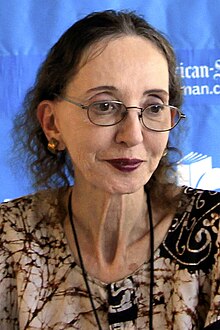
Joyce Carol Oates (born June 16, 1938) is
an American writer. Oates published her first book in 1963 and has since
published over 40 novels, as well as a number of plays and novellas, and many
volumes of short stories, poetry, and nonfiction. She has won many awards for
her writing, including the National Book Award,for her novel them (1969), two O.
Henry Awards, and the National Humanities Medal. Her novels Black Water (1992),
What I Lived For (1994), Blonde (2000), and short story collections The Wheel
of Love (1970) and Lovely, Dark, Deep: Stories (2014) were each finalists for
the Pulitzer Prize.
Oates has taught at Princeton University
since 1978 and is currently the Roger S. Berlind '52 Professor Emerita in the
Humanities with the Program in Creative Writing.
The Vanguard Press published Oates' first
novel, With Shuddering Fall (1964), when she was 26 years old. In 1966, she
published "Where Are You Going, Where Have You Been?", a short story
dedicated to Bob Dylan and written after listening to his song "It's All
Over Now, Baby Blue." The story is loosely based on the serial killer
Charles Schmid, also known as "The Pied Piper of Tucson". It has been
anthologized many times and adapted as a film, Smooth Talk starring Laura Dern
(1985). In 2008, Oates said that of all her published work, she is most noted
for "Where Are You Going, Where Have You Been?". Another early short
story, "In a Region of Ice" (The Atlantic Monthly, August 1966),
features a young, gifted Jewish-American student. It dramatizes his drift into
protest against the world of education and the sober, established society of
his parents, his depression, and eventually murder-cum-suicide. It was inspired
by a real-life incident (as were several of her works) and Oates had been
acquainted with the model of her protagonist. She revisited this subject in the
title story of her collection Last Days: Stories (1984). "In the Region of
Ice" won the first of her two O. Henry Awards.[23] Her second novel was A
Garden of Earthly Delights (1967), first of the so-called Wonderland Quartet
published by Vanguard 1967 to 1971. All were finalists for the annual National
Book Award.
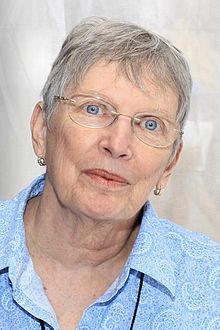
Lois Lowry (born Lois Ann Hammersberg;
March 20, 1937) is an American writer credited with more than thirty children's
books. She has won two Newbery Medals, for Number the Stars in 1990 and The
Giver in 1994. For her contribution as a children's writer, she was a finalist
in 2000 and U.S. nominee again in 2004, as well as a finalist in 2016 for the
biennial, international Hans Christian Andersen Award, the highest recognition
available to creators of children's books. Her book Gooney Bird Greene won the
2002 Rhode Island Children's Book Award. In 2007 she received the Margaret
Edwards Award from the American Library Association for her contribution in
writing for teens.[4] In 2011 she gave the May Hill Arbuthnot Lecture; her
lecture was titled "UNLEAVING: The Staying Power of Gold". She was
also awarded an honorary Doctorate of Letters by Brown University in 2014.
As an author, Lowry is known for writing
about difficult subject matters within her works for children. She has explored
such complex issues as racism, terminal illness, murder, and the Holocaust
among other challenging topics. She has also explored very controversial issues
of questioning authority such as in The Giver quartet. Her writing on such
matters has brought her both praise and criticism. In particular, her work The
Giver, the first novel in The Giver quartet, has been met with a diversity of
reactions from schools in America, some of which have adopted it as a part of
the mandatory curriculum, while others have prohibited the book's inclusion in
classroom studies. A film adaptation of The Giver was released in 2014.
(v.)
1. laugh at someone, often by copying them
in a funny but unkind way:
ex: They were mocking him because he kept
falling off his bike.
ex: She made fun of him by mocking his
limp.
2. to make something appear stupid or not
effective:
ex: The wind mocked their attempts to reach
the shore by pushing the boat further and further out to sea.
(adj)
1. not real but appearing or pretending to
be exactly like something:
ex: mock cream
mock leather
mock surprise
mocking Jay

Mockingjay is a 2010 science fiction novel
by American author Suzanne Collins. It is the last installment of The Hunger
Games, following 2008's The Hunger Games and 2009's Catching Fire. The book
continues the story of Katniss Everdeen, who agrees to unify the districts of
Panem in a rebellion against the tyrannical Capitol. The hardcover and
audiobook editions of Mockingjay were published by Scholastic on August 24,
2010, six days after the ebook edition went on sale. The book sold 450,000
copies in the first week of release, exceeding the publisher's expectations. It
received a generally positive reaction from critics.
The novel was adapted into two films, with
The Hunger Games: Mockingjay – Part 1 released in November 2014 and The Hunger
Games: Mockingjay – Part 2 released a year later.
(adj)
1.
without interest or concern;
not caring; apathetic:
his indifferent attitude toward the
suffering of others.
2. having no bias, prejudice, or
preference; impartial; disinterested.
3. neither good nor bad in character or
quality; average; routine:
an indifferent specimen.
4. not particularly good, important, etc.;
unremarkable; unnotable:
an indifferent success; an indifferent
performance.
5. of only moderate amount, extent, etc.
6. not making a difference, or mattering,
one way or the other.
7. immaterial or unimportant.
(n.)
1. an ethically or morally indifferent act.
2. a person who is indifferent, especially
in matters of religion or politics.
5.Harper Lee

Nelle Harper Lee (April 28, 1926 – February 19, 2016), better known by her pen name Harper Lee, was an American novelist widely known for To Kill a Mockingbird, published in 1960. Immediately successful, it won the 1961 Pulitzer Prize and has become a classic of modern American literature. Though Lee had only published this single book, in 2007 she was awarded the Presidential Medal of Freedom for her contribution to literature. Additionally, Lee received numerous honorary degrees, though she declined to speak on those occasions. She was also known for assisting her close friend Truman Capote in his research for the book In Cold Blood (1966). Capote was the basis for the character Dill in To Kill a Mockingbird.
The plot and characters of To Kill a Mockingbird are loosely based on Lee's observations of her family and neighbors, as well as an event that occurred near her hometown in 1936, when she was 10 years old. The novel deals with the irrationality of adult attitudes towards race and class in the Deep South of the 1930s, as depicted through the eyes of two children. The novel was inspired by racist attitudes in her hometown of Monroeville, Alabama.
Another novel, Go Set a Watchman, was written in the mid-1950s and published in July 2015 as a "sequel", though it was later confirmed to be To Kill a Mockingbird's first draft.
6.Utopia
A utopia (/juːˈtoʊpiə/ yoo-toh-pee-ə) is
an imagined community or society that possesses highly desirable or nearly
perfect qualities for its citizens. The opposite of a utopia is a dystopia. One
could also say that utopia is a perfect 'place' that has been made so there are
no problems.
Utopian ideals often place emphasis on
egalitarian principles of equality in economics, government and justice, though
by no means exclusively, with the method and structure of proposed
implementation varying based on ideology. According to Lyman Tower Sargent
"[t]here are socialist, capitalist, monarchical, democratic, anarchist,
ecological, feminist, patriarchal, egalitarian, hierarchical, racist,
left-wing, right-wing, reformist, free love, nuclear family, extended family,
gay, lesbian, and many more utopias".
The term has been used to describe
intentional communities.
Chronologically, the first recorded utopian
proposal is Plato's Republic. Part conversation, part fictional depiction, and
part policy proposal, Republic would categorize citizens into a rigid class
structure of "golden," "silver," "bronze" and
"iron" socioeconomic classes. The golden citizens are trained in a
rigorous 50-year-long educational program to be benign oligarchs, the
"philosopher-kings." Plato stressed this structure many times in both
quotes by him and in his published works, such as the Republic. The wisdom of
these rulers will supposedly eliminate poverty and deprivation through fairly
distributed resources, though the details on how to do this are unclear. The
educational program for the rulers is the central notion of the proposal. It
has few laws, no lawyers and rarely sends its citizens to war, but hires
mercenaries from among its war-prone neighbors (these mercenaries were
deliberately sent into dangerous situations in the hope that the more warlike
populations of all surrounding countries will be weeded out, leaving peaceful
peoples).
During the 16th century, Thomas More's book
Utopia proposed an ideal society of the same name. Some readers, including
utopian socialists, have chosen to accept this imaginary society as the
realistic blueprint for a working nation, while others have postulated that
More intended nothing of the sort. Some maintain the position that More's
Utopia functions only on the level of a satire, a work intended to reveal more
about the England of his time than about an idealistic society. This
interpretation is bolstered by the title of the book and nation, and its
apparent confusion between the Greek for "no place" and "good
place": "utopia" is a compound of the syllable ou-, meaning "no",
and topos, meaning place. But the homophonic prefix eu-, meaning
"good," also resonates in the word, with the implication that the
perfectly "good place" is really "no place."
Dystopia
A dystopia (from the Greek δυσ- and τόπος, alternatively, cacotopia, kakotopia, or simply anti-utopia) is
a community or society that is undesirable or frightening. It is translated as
"not-good place", an antonym of utopia, a term that was coined by Sir
Thomas More and figures as the title of his best known work, Utopia (the
blueprint for an ideal society with minimal crime, violence and poverty).
Dystopian societies appear in many artistic
works, particularly in stories set in the future. Some of the most famous
examples are George Orwell's 1984 and Aldous Huxley's Brave New World.
Dystopias are often characterized by dehumanization, totalitarian governments,
environmental disaster, or other characteristics associated with a cataclysmic
decline in society. Dystopian societies appear in many sub-genres of fiction
and are often used to draw attention to real-world issues regarding society,
environment, politics, economics, religion, psychology, ethics, science, or
technology. However, some authors also use the term to refer to
actually-existing societies, many of which are or have been totalitarian states,
or societies in an advanced state of collapse and disintegration.
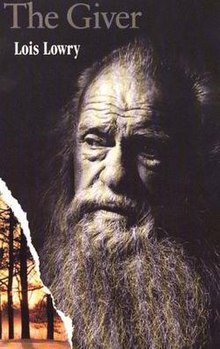
The Giver is a 1993 American young adult dystopian novel by Lois Lowry. It is set in a society which at first appears to be utopian but is revealed to be dystopian as the story progresses. The novel follows a 12-year-old boy named Jonas. The society has eliminated pain and strife by converting to "Sameness", a plan that has also eradicated emotional depth from their lives. Jonas is selected to inherit the position of Receiver of Memory, the person who stores all the past memories of the time before Sameness, as there may be times where one must draw upon the wisdom gained from history to aid the community's decision making. Jonas struggles with concepts of all the new emotions and things introduced to him: whether they are inherently good, evil, or in between, and whether it is even possible to have one without the other. The Community lacks any color, memory, climate, or terrain, all in an effort to preserve structure, order, and a true sense of equality beyond personal individuality.
The Giver won the 1994 Newbery Medal and has sold more than 10 million copies worldwide as of 2014. In Australia, Canada, and the United States, it is on many middle school reading lists, but it is also frequently challenged and it ranked number 11 on the American Library Association list of the most challenged books of the 1990s. A 2012 survey based in the U.S. designated it the fourth-best children's novel of all time.
In 2014, a film adaptation was released, starring Jeff Bridges, Meryl Streep and Brenton Thwaites. The novel forms a loose quartet with three other books set in the same future era, known as The Giver Quartet: Gathering Blue (2000), Messenger (2004), and Son (2012).
8. It's All Over Now,Baby Blue
"It's All Over Now, Baby Blue" is a song written and performed by Bob Dylan and featured on his Bringing It All Back Home album, released on March 22, 1965 by Columbia Records (see 1965 in music). The song was recorded on January 15, 1965 with Dylan's acoustic guitar and harmonica and William E. Lee's bass guitar the only instrumentation. The lyrics were heavily influenced by Symbolist poetry and bid farewell to the titular "Baby Blue." There has been much speculation about the real life identity of "Baby Blue", with suspects including Joan Baez, David Blue, Paul Clayton, Dylan's folk music audience, and even Dylan himself.
"It's All Over Now, Baby Blue" has been covered many times by a variety of artists, including Baez, Bryan Ferry, The Seldom Scene, Them, The Byrds, The Animals, The Chocolate Watchband, Graham Bonnet, Judy Collins, Joni Mitchell, Marianne Faithfull, Falco, The 13th Floor Elevators, the Grateful Dead, Link Wray, Hugh Masekela, Echo and the Bunnymen and Bad Religion. Them's version, released in 1966 influenced garage bands during the mid-60's and Beck later sampled it for his 1996 single "Jack-Ass". The Byrds recorded the song twice in 1965 as a possible follow up single to "Mr. Tambourine Man" and "All I Really Want to Do", but neither recording was released in that form. The Byrds did release a 1969 recording of the song on their Ballad of Easy Rider album (see 1969 in music).
You must leave now, take what you need, you
think will last
But whatever you wish to keep, you better
grab it fast
Yonder stands your orphan with his gun
Crying like a fire in the sun
Look out the saints are comin' through
And it's all over now, Baby Blue
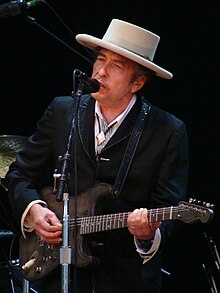
Bob Dylan (/ˈdɪlən/; born Robert Allen Zimmerman; May 24, 1941) is an American
songwriter, singer, painter, and writer. He has been influential in popular
music and culture for more than five decades. Much of his most celebrated work
dates from the 1960s, when his songs chronicled social unrest. Early songs such
as "Blowin' in the Wind" and "The Times They Are
a-Changin'" became anthems for the Civil Rights Movement and anti-war
movement. Leaving behind his initial base in the American folk music revival,
his six-minute single "Like a Rolling Stone", recorded in 1965,
enlarged the range of popular music.
Dylan's lyrics incorporate a wide range of
political, social, philosophical, and literary influences. They defied existing
pop music conventions and appealed to the burgeoning counterculture. Initially
inspired by the performances of Little Richard and the songwriting of Woody
Guthrie, Robert Johnson, and Hank Williams, Dylan has amplified and
personalized musical genres. His recording career, spanning more than 50 years,
has explored the traditions in American song—from folk, blues, and country to
gospel, rock and roll, and rockabilly to English, Scottish, and Irish folk
music, embracing even jazz and the Great American Songbook. Dylan performs with
guitar, keyboards, and harmonica. Backed by a changing lineup of musicians, he
has toured steadily since the late 1980s on what has been dubbed the Never
Ending Tour. His accomplishments as a recording artist and performer have been
central to his career, but his songwriting is considered his greatest
contribution.
Since 1994, Dylan has published seven books
of drawings and paintings, and his work has been exhibited in major art
galleries. As a musician, Dylan has sold more than 100 million records, making
him one of the best-selling artists of all time. He has also received numerous
awards including eleven Grammy Awards, a Golden Globe Award, and an Academy
Award. Dylan has been inducted into the Rock and Roll Hall of Fame, Minnesota
Music Hall of Fame, Nashville Songwriters Hall of Fame, and Songwriters Hall of
Fame. The Pulitzer Prize jury in 2008 awarded him a special citation for
"his profound impact on popular music and American culture, marked by
lyrical compositions of extraordinary poetic power." In May 2012, Dylan
received the Presidential Medal of Freedom from President Barack Obama. In
2016, he was awarded the Nobel Prize in Literature "for having created new
poetic expressions within the great American song tradition"
"Where Are You Going, Where Have You
Been?" is a frequently anthologized short story written by Joyce Carol
Oates. The story first appeared in the Fall 1966 edition of Epoch Magazine. It
was inspired by four Tucson, Arizona murders committed by Charles Schmid, which
were profiled in Life magazine in an article written by Don Moser on March 4,
1966. Oates said that she dedicated the story to Bob Dylan because she was
inspired to write it after listening to his song "It's All Over Now, Baby
Blue."
11.chunky
(n.)
1.
used to describe clothes that are thick and heavy , or jewellery made of large
pieces
ex:
a
chunky sweater
a
chunky necklace
2.
approving used to describe a person who is short and heavy

沒有留言:
張貼留言