1.The Ones Who Walk Away from Omelas

"The Ones Who Walk Away from
Omelas" is a 1973 plotless, short, descriptive work of philosophical
fiction, though popularly classified as a short story, by American writer
Ursula K. Le Guin. With deliberately both vague and vivid descriptions, the
narrator depicts a summer festival in the utopian city of Omelas, whose
prosperity depends on the perpetual misery of a single child.
"The Ones Who Walk Away from
Omelas" was nominated for the Locus Award for Best Short Fiction in 1974
and won the Hugo Award for Best Short Story in 1974.
Publication
Le Guin's piece was originally published in
New Dimensions 3, a hard-cover science fiction anthology edited by Robert
Silverberg, in October 1973. It was reprinted in Le Guin's The Wind's Twelve
Quarters in 1975, and has been frequently anthologized elsewhere.
It has also appeared as an independently
published, 31-page hardcover book for young adults in 1993.
It was republished in the second volume of
the short-story anthology The Unreal and the Real in 2014.
Synopsis
The only chronological element of the work
is that it begins by describing the first day of summer in Omelas, a shimmering
city of unbelievable happiness and delight. In Omelas, the summer solstice is
celebrated with a glorious festival and a race featuring children on horseback.
The vibrant festival atmosphere, however, seems to be an everyday
characteristic of the blissful community, whose citizens, though limited in
their advanced technology to communal (rather than private) resources, are
still intelligent, sophisticated, and cultured. Omelas has no kings, soldiers,
priests, or slaves. The specific socio-politico-economic setup of the community
is not mentioned, but the narrator merely explains that the reader cannot be
sure of every particular.
Self-admittedly, the uncertain narrator
reflects that "Omelas sounds in my words like a city in a fairy tale, long
ago and far away, once upon a time. Perhaps it would be best if you imagined it
as your own fancy bids, assuming it will rise to the occasion, for certainly I
cannot suit you all."[7] The narrator even suggests that, if necessary,
the reader may include an orgy in their mental picture of Omelas.
Everything about Omelas is so abundantly
pleasing that the narrator decides the reader is not yet truly convinced of its
existence and so elaborates upon one final element of the city: its one
atrocity. The city's constant state of serenity and splendor requires that a
single unfortunate child be kept in perpetual filth, darkness, and misery.
Once citizens are old enough to know the
truth, most, though initially shocked and disgusted, ultimately acquiesce with
that one injustice which secures the happiness of the rest of the city.
However, a few citizens, young and old, silently walk away from the city, and
no one knows where they go. The writing ends with "The place they go
towards is a place even less imaginable to most of us than the city of
happiness. I cannot describe it at all. It is possible it does not exist. But
they seem to know where they are going, the ones who walk away from
Omelas."
2.The Handmaid's Tale

The Handmaid's Tale is an American
television series created by Bruce Miller based on the 1985 novel of the same
name by Canadian writer Margaret Atwood. It was ordered by streaming service
Hulu with a straight-to-series order of 10 episodes, with the production
beginning in late 2016.
The first three episodes of the series
premiered on April 26, 2017, with the subsequent seven episodes added on a
weekly basis every Wednesday. In May 2017, The Handmaid's Tale was renewed for
a second season to premiere in 2018.
Plot
In a dystopian near-future, the
totalitarian and Christian fundamentalist government of Gilead rules the former
United States amidst an ongoing civil war. Society is organized along a new,
militarized, hierarchical regime of Bible-inspired social and religious
fanaticism and newly-created social classes, in which women are brutally
subjugated, and by law are not allowed to work, own property, control money, or
read. Widespread infertility due to warfare-induced environmental contamination
has resulted in the conscription of the few remaining fertile women — called
Handmaids, according to Biblical precedent — who are assigned to the homes of
the ruling elite, where they must submit to ritualized sex with their male
masters in order to become pregnant and bear children for those men and their
wives.
The main character, Offred (Elisabeth
Moss), is the Handmaid assigned to the home of Gileadan Commander Fred
Waterford (Joseph Fiennes) and his religious wife Serena Joy (Yvonne
Strahovski), and as such is subject to the strictest rules and constant
scrutiny; an improper word or deed on her part can lead to her execution.
Offred, who is named after her male master like all Handmaids, can remember the
"time before", when she was married with a daughter and had her own
name and identity, but all she can safely do now is follow the rules of Gilead
in the hope that she can someday live free and reunite with her daughter.

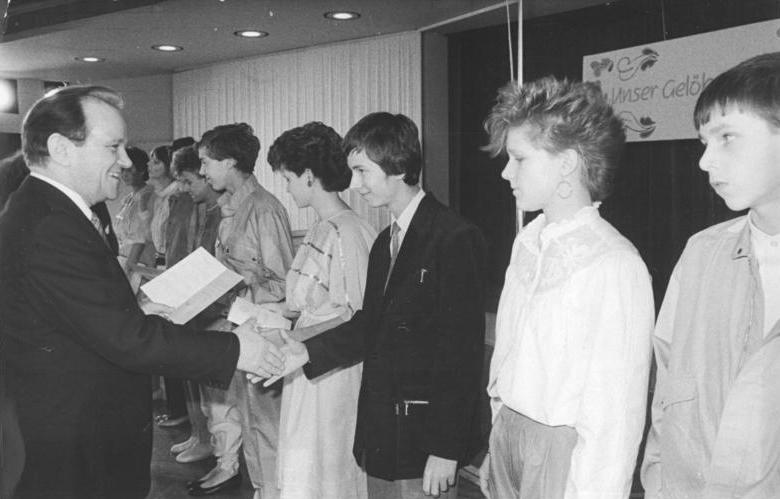
Coming of age is a young person's
transition from being a child to being an adult. The certain age at which this
transition takes place changes in society, as does the nature of the
change.[not in citation given][1] It can be a simple legal convention or can be
part of a ritual or spiritual event, as practiced by many societies. In the
past, and in some societies today, such a change is associated with the age of
sexual maturity (early adolescence), especially menarche and spermarche. In
others, it is associated with an age of religious responsibility. Particularly
in western societies, modern legal conventions which stipulate points in late
adolescence or early adulthood (most commonly 18-21 when adolescents are
generally no longer considered minors and are granted the full rights and
responsibilities of an adult) are the focus of the transition. In either case,
many cultures retain ceremonies to confirm the coming of age, and significant
benefits come with the change.
Coming of age is often a topic of fiction,
in the form of a coming-of-age story. In written literature, a novel which
deals with the psychological and moral growth often associated with coming of
age is sometimes called a bildungsroman. Similar stories that are told in film
are called coming-of-age films.

Tales from Earthsea (Japanese: ゲド戦記? Hepburn: Gedo Senki, literally Ged's War Chronicles) is a 2006
Japanese animated fantasy film directed by Gorō Miyazaki and produced by Studio
Ghibli. The film is based on a combination of plots and characters from the
first four books of Ursula K. Le Guin's Earthsea series: A Wizard of Earthsea,
The Tombs of Atuan, The Farthest Shore, and Tehanu; however, the film's title
is named from the collection of short stories, Tales from Earthsea, made in
2001. The plot was "entirely different" according to the author
Ursula K. Le Guin, who told director Gorō Miyazaki, "It is not my book. It
is your movie. It is a good movie", although she later expressed her
disappointment with the end result.[2] The film is also inspired by the manga
The Journey of Shuna by Hayao Miyazaki. A manga adaptation of the film has been
published in Japan.
Plot
The crew of a war galley are up against a
storm. Suddenly two dragons are fighting above the clouds, during which one is
killed by the other (an occurrence believed impossible).
News of the kingdom declining and nothing
heard from Prince Arren troubles the King of Elad. The Wizard Root speaks of
dragons and men being "one", divided by their particular desires
(freedom and possessions respectively), which is the cause of the world's
"Balance" weakening. Suddenly the King is fatally stabbed in a dark
corridor by a young boy who is revealed to be his own son Arren. The young
prince steals his father's sword and flees the palace while his father dies
from the wound inflicted on him.
In the desert, Arren is rescued from dire
wolves by the Archmage Sparrowhawk. Together they travel to the city of Hort
Town, full of swindlers, slavers and Hazia drug merchants. When Arren explores
the town alone, he rescues a young girl named Therru from slavers, but is
captured by the slave master Hare and his sword is discarded in the sea.
Sparrowhawk rescues Arren from the slave caravan and takes him to a farm run by
Sparrowhawk's friend Tenar, who lives with Therru.
Sparrowhawk's intervention against Hare's
slave caravan angers Lord Cob, a powerful wizard and the ruler of Hort Town,
who wants the archmage brought to the castle. Meanwhile, Sparrowhawk tells
Arren that he seeks a way to restore the upset Balance, then resumes his search
in Hort Town. While there he buys Arren's sword from a merchant's stall and
manages to evade capture from Hare, learning about Cob's castle from the slave
master.
Arren confesses to Therru that he killed
his father and that feels an unknown presence following him. Because of this,
Arren leaves the farm, but is met by the presence, which is a mirror image of
himself. Arren falls unconscious after stumbling into a swamp while fleeing
from the image. Cob takes him to the castle, where he manipulates him into
revealing his "true name", Lebannen, to control him. Meanwhile, Hare
captures Tenar as bait to lure Sparrowhawk into the castle leaving Therru tied
to a post as a messenger. She frees herself, and encounters Sparrowhawk, who gives
her Arren's sword and tells her to stay home and give it to Arren if he
returns. Sparrowhawk breaks into the castle to save Tenar and confronts Cob.
Sparrowhawk learns that Cob is causing the world's Balance to collapse by
opening the door between life and death to try and gain eternal life.
Sparrowhawk tries to warn Cob of the dangers of upsetting the Balance, and Cob
sends Arren out to kill him. Sparrowhawk frees Arren from Cob's control but is
captured by Hare, his power having been weakened within the stronghold of Cob's
castle.
Meanwhile, Therru sees the same copy of
Arren and follows him to the castle, where he reveals that he is the light
within Arren and tells Therru his true name. Therru enters the castle and
learns of Sparrowhawk and Tenar's sunrise execution. She finds Arren, guilty
and hopeless, and brings hope back to him, calling him by his true name and
confides in him her own true name, Tehanu. They rush to rescue Sparrowhawk and
Tenar. Arren confronts Cob, who tries to kill him with a "Summoning
Spell," but he fights back and finally unsheathes his sword, which was
sealed with magic. Arren cuts off Cob's staff-holding hand. Unable to use his
magic powers, Cob rapidly begins to age. He captures Therru and flees to the
highest tower on the castle, with Arren in pursuit. Cornering Cob, Arren tries
to explain what he learned about life and death from Therru and Sparrowhawk to
Cob, but Cob refuses to listen and uses the last of his magic to strangle
Therru to death. However, she does not die as she has eternal life, and instead
becomes a dragon. Therru kills Cob by burning him alive and rescues Arren from
the collapsing castle tower.
Sparrowhawk and Tenar leave the castle, and
meanwhile Therru and Arren land in a field where Therru changes back into a
human. Arren tells Therru he will leave for home to repent for his crime, but
will come back to see her some day. After Arren and Therru reunite with
Sparrowhawk and Tenar, the four of them pitch in to finish the farm chores and
spend time together. Arren and Sparrowhawk depart for Enlad, bidding Therru and
Tenar goodbye. Therru looks up to see dragons peacefully flying in the sky,
indicating that the world's Balance is returning to normal.
5.Lord of the Flies

Lord of the Flies is a 1954 novel by Nobel
Prize-winning English author William Golding. The book focuses on a group of
British boys stranded on an uninhabited island and their disastrous attempt to
govern themselves.
Background
Published in 1954, Lord of the Flies was
Golding's first novel. Although it was not a great success at the time—selling
fewer than three thousand copies in the United States during 1955 before going
out of print—it soon went on to become a best-seller. It has been adapted to
film twice in English, in 1963 by Peter Brook and 1990 by Harry Hook, and once
in Filipino (1976).
The book takes place in the midst of an
unspecified nuclear war. Some of the marooned characters are ordinary students,
while others arrive as a musical choir under an established leader. With the
exception of the choirboys, Sam, and Eric, they appear never to have encountered
each other before. The book portrays their descent into savagery; left to
themselves on a paradisiacal island, far from modern civilization, the
well-educated children regress to a primitive state.
Golding wrote his book as a counterpoint to
R.M. Ballantyne's youth novel The Coral Island, and included specific
references to it, such as the rescuing naval officer's description of the
children's pursuit of Ralph as "a jolly good show, like the Coral
Island".Golding's three central characters—Ralph, Piggy and Jack—have been
interpreted as caricatures of Ballantyne's Coral Island protagonists.
Themes
At an allegorical level, the central theme
is the conflicting human impulses toward civilization and social organization—living
by rules, peacefully and in harmony—and toward the will to power. Themes
include the tension between groupthink and individuality, between rational and
emotional reactions, and between morality and immorality. How these play out,
and how different people feel the influences of these form a major subtext of
Lord of the Flies.[citation needed] The name "Lord of the Flies" is a
literal translation of Beelzebub, from 2 Kings.

Sir William Gerald Golding CBE (19
September 1911 – 19 June 1993) was an English novelist, playwright, and poet.
Best known for his novel Lord of the Flies, he won a Nobel Prize in Literature,
and was also awarded the Booker Prize for fiction in 1980 for his novel Rites
of Passage, the first book in what became his sea trilogy, To the Ends of the
Earth.
Golding was knighted in 1988. He was a
fellow of the Royal Society of Literature. In 2008, The Times ranked Golding
third on their list of "The 50 greatest British writers since 1945"
Biography
Early life
Plaque at Bishop Wordsworth's School,
Salisbury
William Golding was born in his
grandmother's house, 47 Mount Wise, Newquay, Cornwall, and he spent many
childhood holidays there. He grew up in Marlborough, Wiltshire, where his
father (Alec Golding) was a science master at Marlborough Grammar School (1905
to retirement). Alec Golding was a teacher at the school the young Golding and
his elder brother Joseph attended.[6] His mother, Mildred (Curnoe), kept house
at 29, The Green, Marlborough, and was a campaigner for female suffrage. In
1930 Golding went to Brasenose College, Oxford, where he read Natural Sciences
for two years before transferring to English Literature.
Golding took his B.A. degree with Second
Class Honours in the summer of 1934, and later that year a book of his Poems
was published by Macmillan & Co, with the help of his Oxford friend, the
anthroposophist Adam Bittleston.
He was a schoolmaster teaching Philosophy
and English in 1939, then just English from 1945 to 1961 at Bishop Wordsworth's
School, Salisbury, Wiltshire.
Marriage and family
Golding married Ann Brookfield, an
analytical chemist, (p161) on 30 September 1939. They had two children, Judith
and David.
War service
During World War II, Golding joined the
Royal Navy in 1940. He fought (on board a destroyer) and was briefly involved
in the pursuit and sinking of the German battleship Bismarck. He also
participated in the invasion of Normandy on D-Day, commanding a landing ship
that fired salvoes of rockets onto the beaches, and was in action at Walcheren
in which 23 out of 24 assault crafts were sunk.
Death
In 1985, Golding and his wife moved to
Tullimaar House at Perranarworthal, near Truro, Cornwall. He died of heart
failure eight years later, on 19 June 1993. He was buried in the parish
churchyard of Bowerchalke, Wiltshire (near the Hampshire and Dorset county
boundaries). He left the draft of a novel, The Double Tongue, set in ancient
Delphi, which was published posthumously. His son David continues to live at
Tullimaar House.
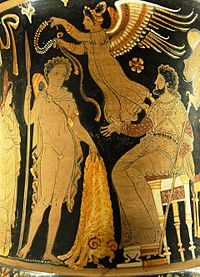
In Greek mythology, the Golden Fleece
(Greek: χρυσόμαλλον δέρας chrysómallon déras)
is the fleece of the gold-haired[a] winged ram, which was held in Colchis.[1]
The fleece is a symbol of authority and kingship. It figures in the tale of the
hero Jason and his crew of Argonauts, who set out on a quest for the fleece by
order of King Pelias, in order to place Jason rightfully on the throne of
Iolcus in Thessaly. Through the help of Medea, they acquire the Golden Fleece.
The story is of great antiquity and was current in the time of Homer (eighth
century BC). It survives in various forms, among which the details vary.
Plot
Athamas the Minyan, a founder of Halos in
Thessaly but also king of the city of Orchomenus in Boeotia (a region of
southeastern Greece), took the goddess Nephele as his first wife. They had two
children, the boy Phrixus (whose name means "curly"—as in ram's
fleece) and the girl Helle. Later Athamas became enamored of and married Ino,
the daughter of Cadmus. When Nephele left in anger, drought came upon the land.
Ino was jealous of her stepchildren and
plotted their deaths: in some versions, she persuaded Athamas that sacrificing
Phrixus was the only way to end the drought. Nephele, or her spirit, appeared
to the children with a winged ram whose fleece was of gold.[b] The ram had been
sired by Poseidon in his primitive ram-form upon Theophane, a nymph[c] and the
granddaughter of Helios, the sun-god. According to Hyginus, Poseidon carried
Theophane to an island where he made her into a ewe, so that he could have his
way with her among the flocks. There Theophane's other suitors could not
distinguish the ram-god and his consort.
Nepheles' children escaped on the yellow
ram over the sea, but Helle fell off and drowned in the strait now named after
her, the Hellespont. The ram spoke to Phrixus, encouraging him,[d] and took the
boy safely to Colchis (modern-day Georgia), on the easternmost shore of the
Euxine (Black) Sea.
There Phrixus sacrificed the winged ram to
Poseidon, essentially returning him to the god.[e] The ram became the
constellation Aries.
Phrixus settled in the house of Aeetes, son
of Helios the sun god. He hung the Golden Fleece preserved from the sacrifice
of the ram on an oak in a grove sacred to Ares, the god of war and one of the
Twelve Olympians. The golden fleece was defended by bulls with hoofs of brass
and breath of fire. It was also guarded by a never sleeping dragon with teeth
which could become soldiers when planted in the ground. The dragon was at the
foot of the tree on which the fleece was placed.

沒有留言:
張貼留言