1. Fantasy

Fantasy is a fiction genre set in an
imaginary universe, often but not always without any locations, events, or
people from the real world. Its roots are in oral traditions, which then
developed into literature and drama. From the twentieth century it has expanded
further into various media, including, film, television, graphic novels, and
video games.
Most fantasy uses magic or other
supernatural elements as a main plot element, theme, or setting. Magic and
magical creatures are common in many of these imaginary worlds. Fantasy is a
subgenre of speculative fiction and is distinguished from the genres of science
fiction and horror by the absence of scientific or macabre themes respectively,
though these genres overlap.
In popular culture, the fantasy genre is
predominantly of the medievalist form. In its broadest sense, however, fantasy
comprises works by many writers, artists, filmmakers, and musicians from
ancient myths and legends to many recent and popular works.
Fantasy is studied in a number of
disciplines including English and other language studies, cultural studies,
comparative literature, history and medieval studies. Work in this area ranges
widely from the structuralist theory of Tzvetan Todorov, which emphasizes the
fantastic as a liminal space, to work on the connections (political, historical
and literary) between medievalism and popular culture.
Traits of fantasy
The identifying trait of fantasy is the
author's reliance on imagination to create narrative elements that do not have
to rely on history or nature to be coherent.[2] This differs from realistic
fiction in that whereas realistic fiction has to attend to the history and
natural laws of reality, fantasy does not. An author applies his or her
imagination to come up with characters, plots, and settings that are impossible
in reality. Many fantasy authors use real-world folklore and mythology as
inspiration;[3] and although for many the defining characteristic of the
fantasy genre is the inclusion of supernatural elements, such as magic,[4] this
does not have to be the case. For instance, a narrative that takes place in an
imagined town in the northeastern United States could be considered realistic
fiction as long as the plot and characters are consistent with the history of
region and the natural characteristics that someone who has been to the
northeastern United States expects; when, however, the narrative takes place in
an imagined town, on an imagined continent, with an imagined history and an
imagined ecosystem, the work becomes fantasy with or without supernatural
elements.
Fantasy has often been compared with
science fiction and horror because they are the major categories of speculative
fiction. Fantasy is distinguished from science fiction by the plausibility of
the narrative elements. A science fiction narrative is unlikely, though seeming
possible through logical scientific or technological extrapolation, whereas
fantasy narratives do not need to be scientifically possible.[5] The imagined
elements of fantasy do not need a scientific explanation to be narratively
functional. Authors have to rely on the readers' suspension of disbelief, an
acceptance of the unbelievable or impossible for the sake of enjoyment, in
order to write effective fantasies. Despite both genres' heavy reliance on the
supernatural, fantasy and horror are distinguishable. Horror primarily evokes
fear through the protagonists' weaknesses or inability to deal with the
antagonists.
2.Ursula K. Le Guin

Ursula Kroeber Le Guin is an American
author of novels, children's books, and short stories, mainly in the genres of
fantasy and science fiction. She has also written poetry and essays. First
published in the 1960s, her work has often depicted futuristic or imaginary
alternative worlds in politics, the natural environment, gender, religion,
sexuality and ethnography. In 2016, The New York Times described her as
"America's greatest living science fiction writer", although she
herself has said she would prefer to be known as an "American
novelist".
She influenced such Booker Prize winners
and other writers as Salman Rushdie and David Mitchell – and notable science
fiction and fantasy writers including Neil Gaiman and Iain Banks.[4] She has
won the Hugo Award, Nebula Award, Locus Award, and World Fantasy Award, each more
than once.[4][5] In 2014, she was awarded the National Book Foundation Medal
for Distinguished Contribution to American Letters.[6] In 2003 she was made a
Grandmaster of Science Fiction, one of only a handful of women writers to take
the top honour in a genre that has come to be dominated by male writers. Le
Guin has resided in Portland, Oregon, since 1959.
3.Parable
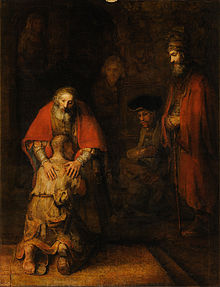
A parable is a succinct, didactic story, in
prose or verse, which illustrates one or more instructive lessons or
principles. It differs from a fable in that fables employ animals, plants,
inanimate objects, or forces of nature as characters, whereas parables have
human characters. A parable is a type of analogy.
Some scholars of the canonical gospels and
the New Testament apply the term "parable" only to the parables of
Jesus, though that is not a common restriction of the term. Parables such as
"The Prodigal Son" are central to Jesus' teaching method in the
canonical narratives and the apocrypha.
History
Parables are often used to explore ethical
concepts in spiritual texts. The Bible contains numerous parables in the
Gospels section of the New Testament (Jesus' parables). These are believed by
some scholars (such as John P. Meier) to have been inspired by mashalim, a form
of Hebrew comparison. Examples of Jesus' parables include the Good Samaritan
and the Prodigal Son. Mashalim from the Old Testament include the parable of
the ewe-lamb (told by Nathan in 2 Samuel 12:1-9) and the parable of the woman
of Tekoah
Parables also appear in Islam. In Sufi
tradition, parables are used for imparting lessons and values. Recent authors
such as Idries Shah and Anthony de Mello have helped popularize these stories
beyond Sufi circles.
Modern parables also exist. A
mid-19th-century example, the Parable of the broken window, criticises a part
of economic thinking.
4.The Prodigal Son
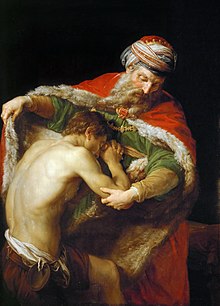
The Parable of the Prodigal Son (also known
as the Two Brothers, Lost Son, Loving Father, or Lovesick Father) is one of the
parables of Jesus and appears in Luke 15:11–32. Jesus Christ shares it with his
disciples, the Pharisees and others.
In the story, a father has two sons. The
younger son asks for his inheritance and after wasting his fortune (the word
"prodigal" means "wastefully extravagant"), becomes
destitute. He returns home with the intention of begging his father to be made
one of his hired servants, expecting his relationship with his father is likely
severed. The father welcomes him back and celebrates his return. The older son
refuses to participate. The father reminds the older son that one day he will
inherit everything. But, they should still celebrate the return of the younger
son because he was lost and is now found.
It is the third and final part of a cycle
on redemption, following the Parable of the Lost Sheep and the Parable of the
Lost Coin. In Revised Common Lectionary and Latin Rite Catholic Lectionary,
this parable is read on the fourth Sunday of Lent (in Year C),;[3] in the
latter it is also included in the long form of the Gospel on the 24th Sunday of
Ordinary Time in Year C, along with the preceding two parables of the cycle. In
the Eastern Orthodox Church it is read on the Sunday of the Prodigal Son.

Elysium or the Elysian Fields (Ancient
Greek: Ἠλύσιον πεδίον, Ēlýsion
pedíon) is a conception of the afterlife that developed over time
and was maintained by some Greek religious and philosophical sects and cults.
Initially separate from the realm of Hades, admission was reserved for mortals
related to the gods and other heroes. Later, it expanded to include those
chosen by the gods, the righteous, and the heroic, where they would remain
after death, to live a blessed and happy life, and indulging in whatever
employment they had enjoyed in life.
The Elysian Fields were, according to
Homer, located on the western edge of the Earth by the stream of Okeanos. In
the time of the Greek oral poet Hesiod, Elysium would also be known as the
Fortunate Isles or the Isles (or Islands) of the Blessed, located in the
western ocean at the end of the earth. The Isles of the Blessed would be
reduced to a single island by the Thebean poet Pindar, describing it as having
shady parks, with residents indulging in athletic and musical pastimes. The
ruler of Elysium varies from author to author: Pindar and Hesiod name Cronus as
the ruler, while the poet Homer in the Odyssey describes fair-haired Rhadamanthus
dwelling there.
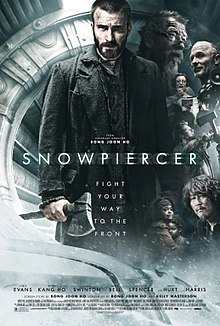
Snowpiercer is a 2013 English-language
South Korean-Czech science fiction thriller film based on the French graphic
novel Le Transperceneige by Jacques Lob, Benjamin Legrand and Jean-Marc
Rochette. The film is directed by Bong Joon-ho, and written by Bong and Kelly
Masterson. The film marks Bong's English-language debut; approximately 80% of
the film was shot in English.
The film stars Chris Evans, Song Kang-ho,
Tilda Swinton, Jamie Bell, Octavia Spencer, Go Ah-sung, John Hurt, and Ed
Harris. The movie takes place aboard the globe-spanning Snowpiercer train which
holds the last remnants of humanity after an attempt at climate engineering in
order to stop global warming has unintentionally created a new ice age. Evans
stars as Curtis Everett, a member of the lower-class tail section passengers as
they lead a revolution against the elite of the front of the train. Filming was
done on train car sets mounted on gimbals at Barrandov Studios in Prague to
simulate the motion of the train.
Snowpiercer was well received by critics,
and appeared on many film critics' top ten film lists of 2014 following its
international release. Praise was primarily directed towards its vision,
direction, and performances, particularly Evans's and Swinton's. Initially
planned for a limited-screen showing in the United States, the critical
response to the film prompted The Weinstein Company to expand the showing to
more theaters and through digital streaming services. Produced at a budget of
$40 million, it remains as the most expensive Korean production ever.
Plot
In 2014, an attempt to counteract global
warming through climate engineering backfires catastrophically, unintentionally
causing an ice age that extinguishes all life except the inhabitants of the
Snowpiercer, a massive train powered by a perpetual motion engine that travels
a circumnavigational track, created by the transportation magnate Wilford. By
2031, elites inhabit the extravagant front cars and the "scum"
inhabit the tail in squalid and brutal conditions. Under watch by Wilford's
guards, they are brought only gelatinous protein bars to eat and kept in their
place in the social order by Minister Mason, while sometimes small children are
taken away.
Conspiring with his mentor Gilliam, Curtis
Everett leads the tail passengers in a revolt that he plans will take them all
the way up to the engine. Overpowering the guards, they release security expert
Namgoong Minsu and his clairvoyant daughter Yona from the prison car so as to
disable the locks between cars. They take the car where insects are ground up
to make their protein bars, and Gilliam suggests that if they take the
subsequent water supply car, they will control any negotiation with Wilford.
Instead, they are ambushed by a mass of masked men with hatchets led by Franco
the Elder under Mason's orders; after a bloody battle Curtis sacrifices his
second-in-command Edgar to win the fight. Mason is taken captive and Curtis,
Namgoong, Yona, and three other rebels: Gilliam's bodyguard Grey, and Andrew
and Tanya who have had their respective children Andy and Timmy taken away
continue on with her as a hostage.
They travel through several luxurious cars
and arrive at a classroom, where the teacher expounds to the children and the
rebels on the greatness of Wilford and the "sacred engine". While
distracted by the celebration of the New Year marking one circumnavigation of
the globe, the teacher ambushes them, killing Andrew before Grey kills her.
Further back, Franco and Mason's soldiers use the same distraction to kill the
rebel army and many of the tail passengers. Franco executes Gilliam, and Curtis
kills Mason in revenge. Curtis' group continues forward, followed by Franco,
leading to a violent fight in a sauna car during which Franco kills Grey and
Tanya before Curtis and Namgoong seemingly kill him.
At the gate to the engine, Namgoong reveals
that he plans to use Kronole, a hallucinogen he has gathered from the elites
they passed, as an explosive to blow a hatch to the outside, as he observed
signs the world outside is thawing. Curtis confesses to him that shortly after
boarding the train, the tail passengers resorted to cannibalism to survive, and
he is haunted by his part in it. He was nearly ready to kill infant Edgar when
Gilliam offered his own arm instead. After years of disdain for Wilford, Curtis
seeks to learn what Wilford's intentions were. Franco is revealed to have
survived and makes his way toward the engine.
Wilford's assistant Claude emerges from the
engine, shoots Namgoong, and invites Curtis inside where he meets an aging
Wilford. Wilford reveals to Curtis that his revolution was actually
orchestrated by himself and Gilliam to reduce the population and maintain the
balance of the sealed ecosystem, and subsequently orders the elimination of 74%
of the remaining tail passengers. He explains the importance of using fear and
chaos to maintain a necessary order and leadership on the train. After letting
Curtis experience being alone for the first time in seventeen years, Wilford
asks Curtis to replace him. Curtis appears ready to accept, when Yona runs in
and pulls up a floorboard, showing Curtis that small children from the tail
section are being trapped as replacement parts for "extinct"
machinery; the tail section only serves to provide this resource to the engine.
Curtis subdues Wilford and sacrifices an arm to save Timmy from this work.
Namgoong revives and finally kills Franco
as Yona lights the fuse on the Kronole. Curtis and Namgoong tightly embrace
Yona and Timmy, protecting them from the blast. The explosion triggers an
avalanche that derails the train. Yona and Timmy, apparently the only
survivors, emerge from the wreckage and see a polar bear, proof that life
exists outside the train.

Big Brother is a television reality game
show based on an originally Dutch TV series of the same name created by producer
John de Mol in 1997. The series follows a group of contestants, known as
HouseGuests, who are living together in a custom-built home under constant
surveillance. The HouseGuests are completely isolated from the outside world,
and can have no communication with those not in the house. The contestants are
competing for a $500,000 grand prize, with weekly competitions and evictions
determining who will win the show. The series takes its name from the character
in George Orwell's novel Nineteen Eighty-Four (1984). The series launched on
July 5, 2000 to a successful start, though ratings and critical reaction
continued to grow increasingly negative. This led to the second season being a
revamp of the show, featuring a more competition-based challenge. The series
has since continued to be a hit for CBS, and is the second longest-running
adaptation of the series to date, after the Spanish adaptation.
The program is the first reality game show
to air exclusively on a streaming platform with a season airing in the fall of
2016 on CBS's streaming service, CBS All Access. CBS also renewed the series
for a 19th and 20th season. The 19th season is scheduled to premiere on June
28, 2017, while the 20th season is expected to air in the summer of 2018.
8.Animal Farm
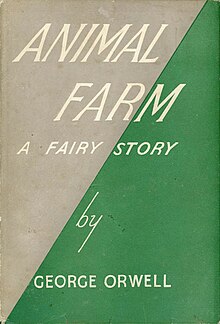
Animal Farm is an allegorical novella by
George Orwell, first published in England on 17 August 1945. According to
Orwell, the book reflects events leading up to the Russian Revolution of 1917
and then on into the Stalinist era of the Soviet Union. Orwell, a democratic
socialist, was a critic of Joseph Stalin and hostile to Moscow-directed
Stalinism, an attitude that was critically shaped by his experiences during the
Spanish Civil War. The Soviet Union, he believed, had become a brutal
dictatorship, built upon a cult of personality and enforced by a reign of
terror. In a letter to Yvonne Davet, Orwell described Animal Farm as a
satirical tale against Stalin ("un conte satirique contre Staline"),
and in his essay "Why I Write" (1946), wrote that Animal Farm was the
first book in which he tried, with full consciousness of what he was doing,
"to fuse political purpose and artistic purpose into one whole".
The original title was Animal Farm: A Fairy
Story; U.S. publishers dropped the subtitle when it was published in 1946, and
only one of the translations during Orwell's lifetime kept it. Other titular
variations include subtitles like "A Satire" and "A Contemporary
Satire".[4] Orwell suggested the title Union des républiques socialistes
animales for the French translation, which abbreviates to URSA, the Latin word
for "bear", a symbol of Russia. It also played on the French name of
the Soviet Union, Union des républiques socialistes soviétiques.
Orwell wrote the book between November 1943
and February 1944, when the UK was in its wartime alliance with the Soviet
Union and the British people and intelligentsia held Stalin in high esteem, a
phenomenon Orwell hated. The manuscript was initially rejected by a number of
British and American publishers, including one of Orwell's own, Victor
Gollancz, which delayed its publication. It became a great commercial success
when it did appear partly because international relations were transformed as
the wartime alliance gave way to the Cold War.
Time magazine chose the book as one of the
100 best English-language novels (1923 to 2005); it also featured at number 31
on the Modern Library List of Best 20th-Century Novels. It won a Retrospective
Hugo Award in 1996, and is included in the Great Books of the Western World
selection.

As a literary device, an allegory is a
metaphor whose vehicle may be a character, place or event, representing
real-world issues and occurrences. Allegory has been used widely throughout
history in all forms of art, largely because it can readily illustrate complex
ideas and concepts in ways that are comprehensible or striking to its viewers,
readers, or listeners.
Writers or speakers typically use
allegories as literary devices or as rhetorical devices that convey hidden
meanings through symbolic figures, actions, imagery, or events, which together
create the moral, spiritual, or political meaning the author wishes to convey.
Etymology
First attested in English in 1382, the word
allegory comes from Latin allegoria, the latinisation of the Greek ἀλληγορία (allegoría), "veiled language, figurative," which in turn comes
from both ἄλλος (allos), "another, different" and ἀγορεύω (agoreuo), "to
harangue, to speak in the assembly"which originate from ἀγορά (agora),
"assembly".
(n.)
1. a plant or animal that has the same
genes as the original from which it was produced
2. informal disapproving someone or
something that looks very much like someone or something else:
ex: Most people saw her as just another
blond-haired, red-lipped Marilyn Monroe clone.
(v.)
1. to create a clone of a plant or animal:
ex: Scientists have already cloned a sheep.
ex: Experiments to try to clone human
embryos have met with hostility from some sections of the public.

沒有留言:
張貼留言