1.redeem
(v)
1. to buy or pay off; clear by payment:
to redeem a mortgage.
2. to buy back, as after a tax sale or a
mortgage foreclosure.
3. to recover (something pledged or
mortgaged) by payment or other satisfaction:
to redeem a pawned watch.
4.to exchange (bonds, trading stamps, etc.)
for money or goods.
5.to convert (paper money) into specie.
6.to discharge or fulfill (a pledge,
promise, etc.).
7.to make up for; make amends for; offset
(some fault, shortcoming, etc.):
ex: His bravery redeemed his youthful
idleness.
refund
(v)
1. to give back or restore (especially
money); repay.
2. to make repayment to; reimburse.
3. to make repayment.
(n)
1. an act or instance of refunding.
2. an amount refunded.
(v)
1. to control or direct by a rule,
principle, method, etc.:
to regulate household expenses.
2. to adjust to some standard or
requirement, as amount, degree, etc.:
to regulate the temperature.
3. to adjust so as to ensure accuracy of
operation:
to regulate a watch.
4. to put in good order
ex: Instead, he muses, why not regulate as
if all people need guns, everywhere?
3. parallel
(adj)
1.
extending in the same
direction, equidistant at all points, and never converging or diverging:
ex: parallel rows of trees.
2.
having the same direction,
course, nature, or tendency; corresponding; similar; analogous:
ex: Canada and the U.S. have many parallel economic interests.
3.
Geometry.
(of straight lines) lying in the same plane but never meeting no
matter how far extended.
(of planes) having common perpendiculars.
(of a single line, plane, etc.) equidistant from another or
others (usually followed by to or with).
4.
Electricity. consisting of or
having component parts connected in parallel:
a parallel circuit.
5.
Music.
a.
(of two voice parts)
progressing so that the interval between them remains the same.
b.
(of a tonality or key) having
the same tonic but differing in mode.
6.
Computers.
a.
of or relating to the
apparent or actual performance of more than one operation at a time, by the
same or different devices (distinguished from serial ):
ex: Some computer systems join more than one CPU forparallel
processing.
b.
of or relating to the
simultaneous transmission or processing of all the parts of a whole, as all the
bits of a byte or all the bytes of a computer word (distinguished from serial
).
(n.)
1. a parallel line or plane.
2. anything parallel or comparable in
direction, course, nature, or tendency to something else.
3. Also called parallel of latitude.
Geography.
a. an imaginary circle on the earth's surface formed by the
intersection of a plane parallel to the plane of the equator, bearing east and
west and designated in degrees of latitude north or south of the equator along
the arc of any meridian.
b. the line representing this circle on a chart or map.
4. something identical or similar in essential
respects; match; counterpart:
a case history without a known parallel.
5. correspondence or analogy:
ex: These two cases have some parallel with
each other.
6.a comparison of things as if regarded
side by side.
7.Electricity. an arrangement of the
components, as resistances, of a circuit in such a way that all positive
terminals are connected to one point and all negative terminals are connected
to a second point, the same voltage being applied to each component.
4. diabetes
(n)
1. any of several disorders characterized
by increased urine production.
2. Also called diabetes mellitus [mel-i-tuh s, muh-lahy-] (Show IPA). a
disorder of carbohydrate metabolism, usually occurring in genetically
predisposed individuals, characterized by inadequate production or utilization
of insulin and resulting in excessive amounts of glucose in the blood and
urine, excessive thirst, weight loss, and in some cases progressive destruction
of small blood vessels leading to such complications as infections and gangrene
of the limbs or blindness.
3. Also called type 1 diabetes,
insulin-dependent diabetes, juvenile diabetes. a severe form of diabetes
mellitus in which insulin production by the beta cells of the pancreas is
impaired, usually resulting in dependence on externally administered insulin,
the onset of the disease typically occurring before the age of 25.
4. Also called type 2 diabetes,
non-insulin-dependent diabetes, adult-onset diabetes, maturity-onset diabetes.
a mild, sometimes asymptomatic form of diabetes mellitus characterized by
diminished tissue sensitivity to insulin and sometimes by impaired beta cell
function, exacerbated by obesity and often treatable by diet and exercise.
5. Also called diabetes insipidus [in-sip-i-duh s] (Show IPA). increased urine
production caused by inadequate secretion of vasopressin by the pituary gland.
(n.)
1. Geometry.
a. a
straight line passing through the center of a circle or sphere and meeting the
circumference or surface at each end.
b. a
straight line passing from side to side of any figure or body, through its
center.
2. the length of such a line.
3. the width of a circular or cylindrical
object.
thermometer
(n)
an instrument for measuring temperature,
often a sealed glass tube that contains a column of liquid, as mercury, that
expands and contracts, or rises and falls, with temperature changes, the
temperature being read where the top of the column coincides with a calibrated
scale marked on the tube or its frame.
hydrometer
(n)
an instrument for determining the specific
gravity of a liquid, commonly consisting of a graduated tube weighted to float
upright in the liquid whose specific gravity is being measured.
5. cana wedding louver

The Wedding at Cana (1563, also The Wedding
Feast at Cana), by Paolo Veronese, is a representational painting that depicts
the Bible story of the Marriage at Cana, a wedding banquet at which Jesus
converts water to wine (John 2:1–11). The work is a large-format (6.77 m × 9.94
m) oil painting executed in the Mannerist style of the High Renaissance
(1490–1527); as such, The Wedding Feast at Cana is the most expansive canvas
(67.29 m2) in the paintings collection of the Musée du Louvre.
As a Mannerist painting, The Wedding at
Cana comprehends the stylistic influences of the ideals of compositional
harmony of artists such as Leonardo, Raphael, and Michelangelo, especially his
early paintings. Whereas the art of the High Renaissance emphasized ideal
proportion, balance, and beauty, Mannerism exaggerated those ideals of figure,
light, and colour, with asymmetric and unnaturally elegant compositions.
In executing the painting in the Mannerist
style of compositional tension and instability, Veronese used technical
artifice, social intellect, and cultural sophistication for The Wedding at Cana
to tell a Biblical story to the viewer.
6. cain and abel

Cain and Abel (Hebrew: הֶבֶל ,קַיִן Qayin, Heḇel; Arabic: قابيل، هابيل Qābīl, Hābīl) were sons of Adam and Eve.[1] Cain, the firstborn,
tilled the soil, and his brother Abel was a shepherd. The brothers made
sacrifices to God, each of his own produce, but God favored Abel's sacrifice
instead of that of Cain. Cain murdered Abel. God punished Cain to a life of
wandering, but set a mark on him so that no man would kill him. Cain then dwelt
in the land of Nod (נוד, "wandering"), where he built a city and fathered the
line of descendants beginning with Enoch. The narrative never explicitly states
Cain's motive (though it does describe him as being wrathful, and his motive is
traditionally assumed to be envy), nor God's reason for rejecting Cain's
sacrifice, nor details on the identity of Cain's wife. Some traditional
interpretations consider Cain to be the originator of evil, violence, or greed.
7. Francis of Assisi

Saint Francis of Assisi (Italian: San
Francesco d'Assisi), born Giovanni di Pietro di Bernardone, informally named as
Francesco (1181/1182 – 3 October 1226), was an Italian Roman Catholic friar,
deacon and preacher. He founded the men's Order of Friars Minor, the women’s
Order of Saint Clare, the Third Order of Saint Francis and the Custody of the
Holy Land. Francis is one of the most venerated religious figures in history.
Pope Gregory IX canonized Francis on 16
July 1228. Along with Saint Catherine of Siena, he was designated Patron saint
of Italy. He later became associated with patronage of animals and the natural
environment, and it became customary for Catholic and Anglican churches to hold
ceremonies blessing animals on his feast day of 4 October.
In 1219, he went to Egypt in an attempt to
convert the Sultan to put an end to the conflict of the Crusades. By this
point, the Franciscan Order had grown to such an extent that its primitive
organizational structure was no longer sufficient. He returned to Italy to
organize the Order. Once his community was authorized by the Pope, he withdrew
increasingly from external affairs. Francis is also known for his love of the
Eucharist. In 1223, Francis arranged for the first Christmas live nativity
scene. According to Christian tradition, in 1224 he received the stigmata
during the apparition of Seraphic angels in a religious ecstasy making him the
first recorded person in Christian history to bear the wounds of Christ's Passion.
He died during the evening hours of 3 October 1226, while listening to a
reading he had requested of Psalm 142 (141).
8. Holy Grail
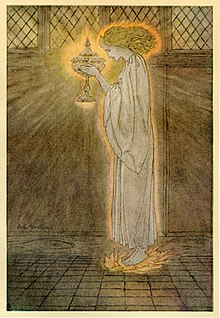
The Holy Grail is a vessel that serves as
an important motif in Arthurian literature. Different traditions describe it as
a cup, dish or stone with miraculous powers that provide happiness, eternal
youth or sustenance in infinite abundance.
A "grail", wondrous but not
explicitly holy, first appears in Perceval, le Conte du Graal, an unfinished
romance written by Chrétien de Troyes around 1190.[1] Here, it is a
processional salver used to serve at a feast. Chrétien's story attracted many
continuators, translators and interpreters in the later 12th and early 13th
centuries, including Wolfram von Eschenbach, who perceived the grail as a great
precious stone that fell from the sky. In the late 12th century, Robert de
Boron wrote in Joseph d'Arimathie that the Grail was Jesus's vessel from the
Last Supper, which Joseph of Arimathea used to catch Christ's blood at the
Crucifixion. Thereafter, the Holy Grail became interwoven with the legend of
the Holy Chalice, the Last Supper cup, a theme continued in works such as the
Vulgate Cycle, the Post-Vulgate Cycle, and Thomas Malory's Le Morte d'Arthur
Scholars have long speculated on the
origins of the Holy Grail before Chrétien, suggesting that it may contain
elements of the trope of magical cauldrons from Celtic mythology combined with
Christian legend surrounding the Eucharist.
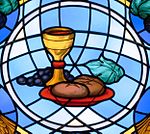
The Eucharist /ˈjuːkərɪst/ (also called Holy
Communion, the Lord's Supper, among other names) is a Christian rite that is
considered a sacrament in most churches and an ordinance in others. According
to the New Testament, the rite was instituted by Jesus Christ during his Last
Supper; giving his disciples bread and wine during the Passover meal, Jesus
commanded his followers to "do this in memory of me" while referring
to the bread as "my body" and the wine as "my blood".
Through the Eucharistic celebration Christians remember Christ's sacrifice of
himself on the cross.
The elements of the Eucharist, bread
(leavened or unleavened) and wine (or grape juice), are consecrated on an altar
(or table) and consumed thereafter. Communicants (that is, those who consume
the elements) may speak of "receiving the Eucharist", as well as
"celebrating the Eucharist". Christians generally recognize a special
presence of Christ in this rite, though they differ about exactly how, where,
and when Christ is present.[4] While all agree that there is no perceptible
change in the elements, Catholics believe that they actually become the body
and blood of Christ (transubstantiation). Lutherans believe the true body and
blood of Christ are really present "in, with, and under" the forms of
the bread and wine (sacramental union). Reformed Christians believe in a real
but purely spiritual presence of Christ in the Eucharist. Others, such as the
Plymouth Brethren, take the act to be only a symbolic reenactment of the Last
Supper.
In spite of differences between Christians
about various aspects of the Eucharist, there is, according to the Encyclopædia
Britannica, "more of a consensus among Christians about the meaning of the
Eucharist than would appear from the confessional debates over the sacramental
presence, the effects of the Eucharist, and the proper auspices under which it
may be celebrated."
10. allegorical

As a literary device, an allegory is a
metaphor whose vehicle may be a character, place or event, representing
real-world issues and occurrences. Allegory has been used widely throughout
history in all forms of art, largely because it can readily illustrate complex
ideas and concepts in ways that are comprehensible or striking to its viewers,
readers, or listeners.
Writers or speakers typically use
allegories as literary devices or as rhetorical devices that convey hidden
meanings through symbolic figures, actions, imagery, or events, which together
create the moral, spiritual, or political meaning the author wishes to convey.

沒有留言:
張貼留言