青少年文學 Week 7
1. Henry Wadsworth Longfellow

Henry Wadsworth Longfellow (February 27,
1807 – March 24, 1882) was an American poet and educator whose works include
"Paul Revere's Ride", The Song of Hiawatha, and Evangeline. He was
also the first American to translate Dante Alighieri's Divine Comedy, and was
one of the five Fireside Poets.
Longfellow was born in Portland, Maine,
which was then a part of Massachusetts. He studied at Bowdoin College. After
spending time in Europe he became a professor at Bowdoin and, later, at Harvard
College. His first major poetry collections were Voices of the Night (1839) and
Ballads and Other Poems (1841). Longfellow retired from teaching in 1854, to
focus on his writing, living the remainder of his life in Cambridge,
Massachusetts, in a former Revolutionary War headquarters of George Washington.
His first wife Mary Potter died in 1835, after a miscarriage. His second wife
Frances Appleton died in 1861, after sustaining burns when her dress caught
fire. After her death, Longfellow had difficulty writing poetry for a time and
focused on translating works from foreign languages. He died in 1882.
Longfellow wrote many lyric poems known for
their musicality and often presenting stories of mythology and legend. He
became the most popular American poet of his day and also had success overseas.
He has been criticized, however, for imitating European styles and writing
specifically for the masses.
2.The Blind side
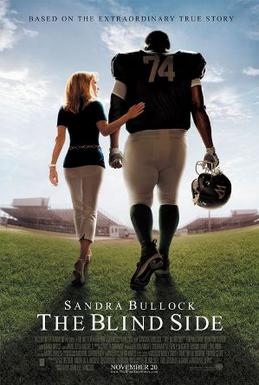
The Blind Side is a 2009 American
biographical sports drama film. It was written and directed by John Lee
Hancock, and based on the 2006 book The Blind Side: Evolution of a Game by
Michael Lewis.[2][3] The storyline features Michael Oher, an offensive lineman
who played for the Baltimore Ravens and the Tennessee Titans, and currently is
signed with the Carolina Panthers in the NFL. The film follows Oher from his
impoverished upbringing, through his years at Wingate Christian School (a
fictional representation of Briarcrest Christian School in Memphis,
Tennessee),[4] his adoption by Sean and Leigh Anne Tuohy, to his position as
one of the most highly coveted prospects in college football, then finally
becoming a first-round pick of the Ravens.
Quinton Aaron stars as Michael Oher,
alongside Sandra Bullock as Leigh Anne Tuohy, Tim McGraw as Sean Tuohy, and
Kathy Bates as Miss Sue.[2] The movie also features appearances by several
current and former NCAA coaches, including SEC coaches Houston Nutt and Ed
Orgeron (Oher's coaches in college, though Nutt represented Arkansas at the
time and therefore does so in the film) and Nick Saban (who was at LSU at the
time the movie is set and represents it in the film, but was the head coach at
Alabama at the time of filming), former coaches Lou Holtz, Tommy Tuberville,
Phillip Fulmer, as well as recruiting analyst Tom Lemming.[5]
The Blind Side grossed over $300 million.
Bullock went on to win the Academy Award for Best Actress, as well as the
Golden Globe Award for Best Actress and the Screen Actors Guild Award for
Outstanding Performance by a Female Actor in a Leading Role. The film also
received an Academy Award nomination for Best Picture, which was considered a
surprise for the producers.
3.The Tell Tale Heart

"The Tell-Tale Heart" is a short
story by Edgar Allan Poe first published in 1843. It is told by an unnamed
narrator who endeavors to convince the reader of his sanity, while describing a
murder he committed. The victim was an old man with a filmy
"vulture-eye", as the narrator calls it. The murder is carefully
calculated, and the murderer hides the body by dismembering it and hiding it
under the floorboards. Ultimately, the narrator's feelings of guilt, or a
mental disturbance, result in him hearing the dead man's beating heart.
The story was first published in James
Russell Lowell's The Pioneer in January 1843. "The Tell-Tale Heart"
is widely considered a classic of the Gothic fiction genre and is one of Poe's
most famous short stories.
It is unclear what relationship, if any,
the old man and his murderer share. The narrator denies having any feelings of
hatred or resentment for the man who had, he says, never wronged him. He also
denies that he killed for greed. The specific motivation for murder, the
relationship between narrator and old man, and other details are left unclear.
It has been suggested that the old man is a father figure, the narrator's
landlord, or that the narrator works for the old man as a servant, and that
perhaps his "vulture-eye" represents some sort of veiled secret, or
power. The ambiguity and lack of details about the two main characters stand in
stark contrast to the specific plot details leading up to the murder.
4.To act
(V.)
1. Take action; do something.
2. act on Take action according to or in
the light of
3. act for Take action in order to bring
about.
4. act for/on behalf of Represent (someone)
on a contractual, legal, or paid basis.
5. act from/out of Be motivated by.
6. Behave in the way specified.
‘they challenged a man who
was seen acting suspiciously’
‘he acts as if he owned
the place’
‘try to act like civilized
adults’
7. Perform a role in a play, film, or
television.
‘she acted in her first
professional role at the age of six’
5.Tomorrow and tomorrow and tomorrow
Tomorrow and tomorrow and tomorrow is the
beginning of the second sentence of one of the most famous soliloquies in
Shakespeare's tragedy Macbeth. It takes place in the beginning of the 5th scene
of Act 5, during the time when the English troops, led by Malcolm and Macduff,
are approaching Macbeth's castle to besiege it. Macbeth, the play's
protagonist, is confident that he can withstand any siege from Malcolm's
forces. He hears the cry of a woman and reflects that there was a time when his
hair would have stood on end if he had heard such a cry, but he is now so full
of horrors and slaughterous thoughts that it can no longer startle him.
Seyton then tells Macbeth of Lady Macbeth's
death, and Macbeth delivers this soliloquy as his response to the news.[1]
Shortly afterwards he is told of the apparent movement of Birnam Wood towards
Dunsinane Castle (as the witches previously prophesied to him), which is
actually Malcolm's forces having disguised themselves with tree branches so as
to hide their numbers as they approach the castle. This sets the scene for the
final events of the play and Macbeth's death at the hands of Macduff.
6.Because I could not stop for Death

"Because I could not stop for
Death" is a lyrical poem by Emily Dickinson first published posthumously
in Poems: Series 1 in 1890. The persona of Dickinson's poem meets personified
Death. Death is a gentleman caller who takes a leisurely carriage ride with the
speaker to her grave. According to Thomas H. Johnson's variorum edition of 1955
the number of this poem is 712.
Because I could not stop for Death,
He kindly stopped for me;
The carriage held but just ourselves
And Immortality.
We slowly drove, he knew no haste,
And I had put away
My labor, and my leisure too,
For his civility.
We passed the school where children played,
Their lessons scarcely done;
We passed the fields of gazing grain,
We passed the setting sun.
We paused before a house that seemed
A swelling of the ground;
The roof was scarcely visible,
The cornice but a mound.
Since then 'tis centuries; but each
Feels shorter than the day
I first surmised the horses' heads
Were toward eternity.
7.gazing grain
Death is personified as a gentleman caller
or suitor. Thomas H. Johnson calls him "one of the great characters of
literature." But exactly what kind of person is he?
Is Death a kind, polite suitor? The speaker
refers to his "kindness" and "civility." He drives her
slowly; is this an expression of tact and consideration for her? If he is the
courteous suitor, then Immortality, who is also in the carriage (or hearse)
would be their chaperon, a silent one.
Is Death actually a betrayer, and is his
courtly manner an illusion to seduce her? Because of his kindness in stopping
for her, she agrees to go with him ("put away / My labor and my leisure
too"). Is Death really cruel? She is not properly dressed for their
journey; she is wearing only a gossamer gown and tulle tippet (gossamer: very
light, thin cloth; tulle: a thin, fine netting used for veils, scarfs, etc.;
tippet: covering for the shoulders). Is Immortality really an accomplice to
Death's deception?
The drive symbolizes her leaving life. She
progresses from childhood, maturity (the "gazing grain" is ripe) and
the setting (dying) sun to her grave. The children are presented as active in
their leisure ("strove"). The images of children and grain suggest
futurity, that is, they have a future; they also depict the progress of human
life. Is there irony in the contrast between her passivity and inactivity in
the coach and their energetic activity?
The word "passed" is repeated
four times in stanzas three and four. They are "passing" by the
children and grain, both still part of life. They are also "passing"
out of time into eternity. The sun passes them as the sun does everyone who is
buried. With the sun setting, it becomes dark, in contrast to the light of the
preceding stanzas. It also becomes damp and cold ("dew grew quivering and
chill"), in contrast to the warmth of the preceding stanza. Also the
activity of stanza three contrasts with the inactivity of the speaker in
stanzas four and five. They pause at the grave. What is the effect of describing
it as a house?
In the final stanza, the speaker has moved
into death; the language becomes abstract; in the previous stanzas the imagery
was concrete and specific. What is Dickinson saying about death or her
knowledge of death with this change? The speaker only guesses
("surmised") that they are heading for eternity. Why does she have to
guess? She has experienced life, but what does she specifically know about
being dead? And why didn't death tell her? If eternity is their goal, can
Immortality be a passenger? Or is this question too literal-minded?
Why does Dickinson change from past tense
to present tense with the verb "feels" (line 2, stanza 6)? Does
eternity have an end?
In this poem, exclusion occurs differently
than it does in "The soul selects her own society" Here the speaker
is excluded from activities and involvement in life; the dead are outside
"the ring" of life. As you read Dickinson's poems, notice the ways in
which exclusion occurs and think about whether it is accurate to characterize
her as the poet of exclusion.
8.making a mockery
1.
to make a deliberate parody
or a poor imitation of something.
ex: What a mess. You made a mockery of the
task. You have made a mockery of my position!
2.
to make something seem stupid
or without value
ex:The film makes a mockery of a serious
illness.
ex: Spending in the last election made a
mockery of campaign finance laws.
3.
to make something seem stupid
or without value
ex: The fact that he sent his children to
private school makes a mockery of his socialist principles.
9. gothic
may refer to:
1.
Germanic people
Goths or Gothic people, the ethnonym of a
group of East Germanic tribes
Gothic language, an extinct East Germanic
language, spoken by the Goths
Crimean Gothic, the Gothic language spoken
by the Crimean Goths
Gothic alphabet, one of the alphabets used
to write the Gothic language
Gothic (Unicode block), a collection of
Unicode characters of the Gothic alphabet
2.
Medieval culture
Gothic art, a Medieval art movement
Gothic architecture
Gothic Revival architecture
3.
Romanticism
Gothic fiction or Gothic Romanticism, a
British literary genre
Gothic Revival architecture
Goth subculture[edit]
Goth subculture
Gothic fashion
10.Spring break
Spring break is a U.S. phenomenon and an
academic tradition which started during the 1930s in the United States and is
observed in some other western countries. Spring break is also a vacational
period in early spring at universities and schools in various countries in the
world, where it is known by names such as Easter vacation, Easter Holiday,
March break, spring vacation, Mid-Term Break, study week, reading week, reading
period, or Easter week, depending on regional conventions. However, these
vacations differ from Spring Break in the United States.
11. Equinox
1.
The equinox is defined as a
day that occurs twice per year when the sun crosses the equator and the night
and day are the same length. A day in March that is the beginning of spring and
a day in September that is the beginning of fall, are examples of the equinox.
2.
the time when the sun in its
apparent annual movement along the ecliptic crosses the celestial equator,
making night and day of equal length in all parts of the earth: in the Northern
Hemisphere the vernal equinox occurs about March 21 and marks the beginning of
spring, and the autumnal equinox occurs about September 22 and marks the
beginning of autumn either of the two points on the celestial sphere where the
sun's path crosses the celestial equator also called equinoctial point.
12.one sitting pose
during one limited period of time , without
stopping
ex: I enjoyed the book so much that I read it
all in one sitting.

